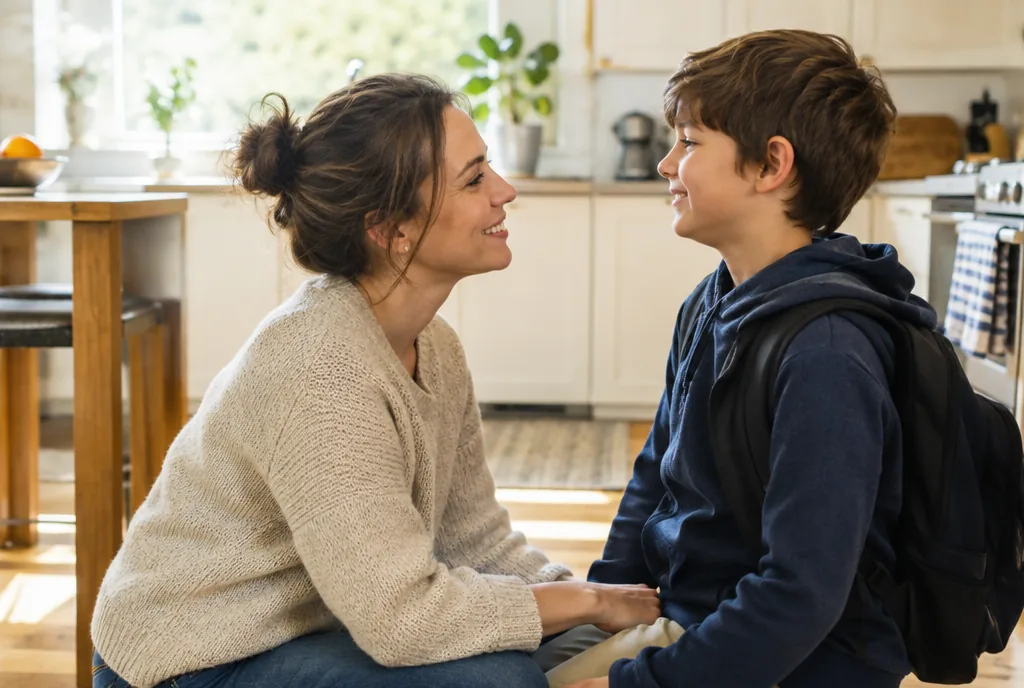
Learning how to teach gratitude starts with a shift: help your child notice more than the thing they received. Help them see the person, time, and care behind it. A useful four-part pattern is simple enough to use at the dinner table or after a birthday gift: notice something good, think about why it happened, feel the positive emotion, and do something in response. Over time, that turns “thank you” from a prompt into a way of paying attention.
Teach gratitude by making other people’s effort visible
A child can receive a gift, a ride, or a favor without yet recognizing what it took. Give the moment a little more detail. Instead of asking for a quick “thanks,” try: “Grandma knitted that sweater for you. What could you say about the time she spent making it?” A specific response might be, “Thank you, Grandma, for knitting this sweater.”
This approach follows four connected steps. Your child notices the sweater, thinks about why Grandma made it, feels pleased or cared for, then does something in response. That response may be words, a drawing, a card, or a helpful act. The point is not a perfect performance. It is helping a child connect a benefit with another person’s intention.
Modeling gratitude matters because children learn it by watching. Let them hear you thank a partner, neighbor, or store clerk. At breakfast, you might say, “Thank you for getting up when I asked this morning.” In a study of more than 100 parents of children ages 6 to 9, the most helpful responses to ungrateful behavior were guiding children to recognize another person’s effort and discuss that person’s perspective.
Use five small gratitude practices your family can repeat
Gratitude for kids works best when it has a place in ordinary life, not only at holidays. Pick one practice and repeat it long enough for it to feel familiar.
- Make a gratitude jar. Decorate an empty jar. Each day, family members write one thank-you on a slip of paper and put it inside. At the end of the week, read the notes together.
- Take a 10-minute gratitude walk. Take turns naming something you appreciate as you walk. A child might notice a yellow leaf; you might appreciate a crossing guard who helps people cross safely.
- Hold a dinner gratitude round. Give every person a turn to name one good thing from the day. A family gratitude routine can take five minutes.
- Post gratitude stickies. Put short thank-you notes on a bathroom mirror or refrigerator. “Thanks for setting the table” makes the connection between a helpful act and appreciation visible.
- Try Three Good Things. At bedtime, write down or say three good things that happened that day. Research on this exercise has reported long-term increases in life satisfaction of more than 10%.
Specificity keeps these practices from becoming empty rituals. “I am grateful for my friend” is a start; “I am grateful that Maya waited for me at recess” helps a child remember what happened and why it mattered.
Match gratitude activities to your child’s age
The activity should fit what your child can understand and do now. Younger children need objects, pictures, and short exchanges. Older children can reflect on another person’s experience more deeply.
| Age | A gratitude activity to try |
|---|---|
| 0–1 | Use “please” and “thank you” consistently in daily routines so the words become familiar. |
| 1–3 | Go on a gratitude treasure hunt at home or outside, naming appealing things you find together. |
| 3–5 | Decorate a gratitude box and add stones, photos, or drawings that represent good things. |
| 6–10 | Make a gratitude collage with pictures of people, places, and things the child appreciates. |
| 13+ | Invite your teen to interview an adult who has moved through a difficult period of life. |
Giving can add another kind of perspective. A young child can choose toys they no longer need to donate. A teen can volunteer for a day at a food pantry or soup kitchen. Before and after, talk about what the child noticed and how it felt to help. Doing something for others gives children a concrete experience of generosity rather than only a lecture about it.
How to teach gratitude to a 5-year-old without making it abstract
Start with one concrete thing each evening: “What made you happy today?” A 5-year-old does not need a broad instruction such as “Be grateful for your good life.” They can answer a focused question: “Did you enjoy the red toy car Aunt Lisa gave you?” Children age 4 and up can keep a gratitude journal with drawings instead of words—a sun for nice weather or a heart for Mom.
At about age 5, children gain the ability to understand another person’s perspective. Use that new skill gently: “How do you think Grandma feels when you thank her?” On a walk, you can use the four parts of gratitude without naming them. Notice a beautiful stone, talk about why it catches your eye, pause over the pleasant feeling, then put it in a pocket or gratitude box.
For preschoolers, short and concrete beats elaborate. One object, one feeling, and one response are enough. A child who has not yet mastered this is not failing; the ability to feel gratitude develops around ages 5 to 7 as perspective-taking develops.
Build a gratitude journal your child will actually use
A gratitude journal can be a plain notebook, not a project that has to look impressive. Choose it together, set a regular time such as before bed, and begin with one prompt: “What made you smile today?” Let your child write, draw, or dictate an answer. Do not force participation.
- For ages 4 to 7, one entry a day is enough.
- For ages 8 to 12, limit the journal to three entries a day.
- Use drawings for children who are not yet readers or writers.
- Keep the focus on a real moment, not on finding a “right” answer.
In a 2008 study of 221 adolescents with an average age of 12, participants who counted blessings daily showed more optimism, higher life satisfaction, and fewer negative emotions than a group that recorded everyday events. The journal is one way to create a regular moment for that kind of noticing.
When your child seems ungrateful, look for what is underneath
Ungrateful behavior can look different from one day to the next: no “thank you,” a backpack left in the hallway, a tantrum after a denied request, or “Everyone else has more.” Rather than deciding your child is simply ungrateful, start with curiosity. Consumer pressure, social comparison, and difficulty tolerating uncomfortable feelings can all be part of the picture. For a younger child, gratitude may still be a developing ability.
Try three responses before turning the moment into a moral lesson. First, build feeling vocabulary: “Are you disappointed that we are not buying that today?” Second, hold a clear boundary around “no.” Third, create chances to practice waiting for a reward. Clear limits and delayed rewards give children practice with disappointment and patience.
With a teen, soft confrontation can open a conversation: “I get the feeling you are taking this for granted. Can you tell me what makes you happy about it?” Punishment, such as taking away a toy, is the least effective response to ingratitude. Parent self-blame is counterproductive too. Return instead to effort, perspective, and a calm limit.
Reduce entitlement without demanding gratitude
Entitlement is not solved by ordering a child to feel thankful. Research on overindulgence describes three patterns that can foster it: giving too much, over-nurturing a child’s development, and neglecting a child’s needs. The answer is neither excess nor harshness; it is consistent responsibility and room to contribute.
- Give less rather than making every want an automatic purchase.
- Let children earn some things through age-appropriate chores.
- Model gratitude out loud in daily interactions.
- Ask children to reflect on what other people did for them.
- Give children regular household responsibilities.
These steps do not require a child to be cheerful about every limit. Wanting more is normal. The goal is to help them hold both ideas at once: “I wish I could have that” and “I can appreciate what I have and what others do for me.”
Know what gratitude can and cannot do for mental health
Research links gratitude with improved mood, stronger social bonds, and better sleep quality. A systematic review of 217 studies found that gratitude interventions significantly reduced anxiety and depressive symptoms. For children and teens, a brief bedtime practice may also be a quiet way to end the day by noticing something good.
Gratitude is not a diagnosis and it is not a replacement for care. See a doctor or qualified mental-health professional when persistent sadness, anxiety, changes in sleep, or worries about safety interfere with daily life. A gratitude routine can sit alongside appropriate support; it should not be used to dismiss a child’s distress.
Common gratitude myths that get in the way
“Saying thank you is enough.”
Words are a useful start, but gratitude has more parts. Help your child notice what happened, consider the effort behind it, name the feeling, and choose a response. A thank-you note can guide all four steps.
“I should force my child to be grateful.”
You can set expectations for respectful behavior without demanding an emotion. Create openings to notice kindness, offer simple language, and model the response yourself. Gratitude grows more naturally when children have repeated chances to practice it.
“A grateful child never wants more.”
Children can want a new pair of shoes or a toy and still appreciate what they have. Listen to the disappointment, keep the boundary, and return attention to needs, wants, and other people’s effort.
“One activity will fix entitlement.”
A gratitude jar is not a cure-all. Consistent modeling, clear limits, reflection, household duties, and chances to help others work together over time.
Frequently Asked Questions
How do you teach gratitude to kids?
Use the four-part pattern: help your child notice something good, think about why it happened, feel the positive emotion, and do something in response. Model specific thanks and use short family routines so the skill becomes familiar.
How do you teach gratitude to a 5-year-old?
Keep it concrete. Ask for one good thing at bedtime, use drawings in a gratitude journal, and ask simple perspective questions such as, “How might Grandma feel when you thank her?”
How do you teach ungrateful kids to be grateful?
Look beyond the behavior. Discuss feelings, keep a clear limit when the answer is no, practice waiting, and help your child notice another person’s effort. Avoid punishment and parent self-blame as responses to ingratitude.
What are 5 ways to practice gratitude?
Try a gratitude jar, a 10-minute gratitude walk, a five-minute dinner round, gratitude stickies, or Three Good Things at bedtime. Choose one practice your family can repeat.
What causes a lack of gratitude in children?
Consumer pressure, social comparison, difficulty tolerating uncomfortable feelings, and overindulgence can contribute. For children younger than about 5 to 7, gratitude may also be developmentally emerging.